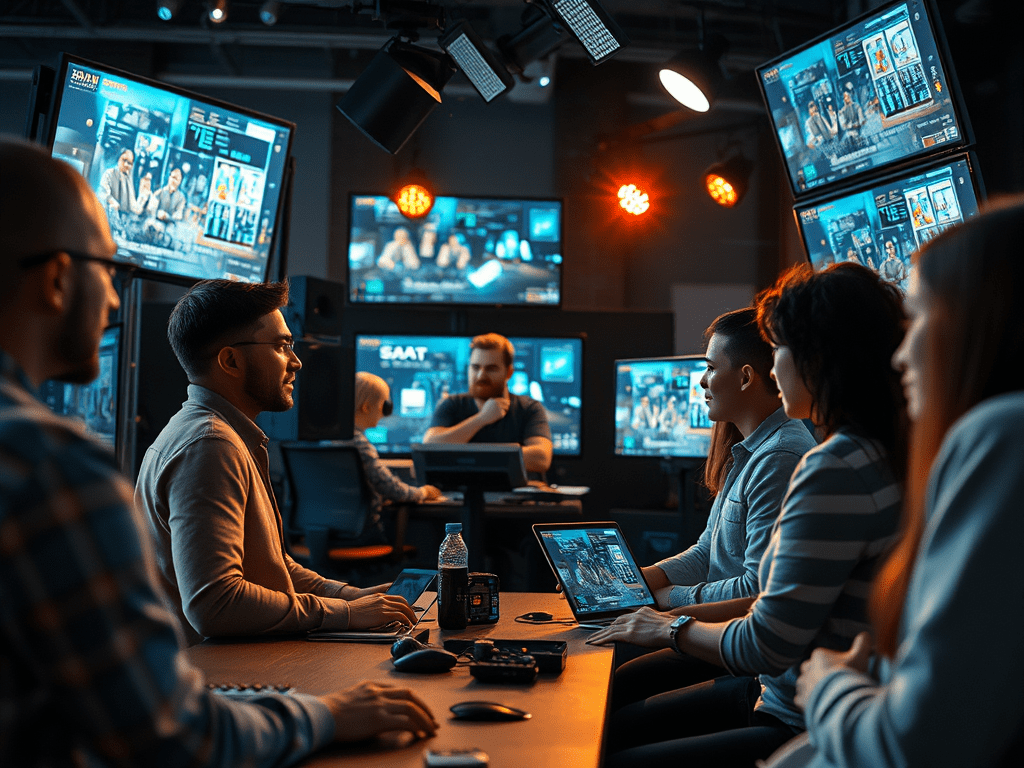
The integration of cutting-edge tech is driving the evolution of content creation. Technologies like AI (Artificial Intelligence) and USD (Universal Scene Description) are at the forefront. These technologies represent a new way in how live and on-demand content is produced and experienced. With the power of AI and USD, content is no longer a one-size-fits-all experience. It is becoming personalized. It’s also becoming interactive and infinitely scalable.
AI in Content Creation
Artificial Intelligence is transforming the way media assets are created, managed, and delivered. In streaming workflows, LLMs (large language models) enhance content creation processes, from generating real-time interactive experiences to manipulating assets dynamically. Here’s how AI is revolutionizing live on-demand streaming:
- Real-Time Asset Manipulation: AI enables real-time control over assets, for immediate adjustments based on user interactions or predefined personalization criteria. Subtle facial expressions are examples of AI-driven automation. Entire environment changes also exemplify this automation. They dynamically modify live-streamed and on-demand assets to meet an audience’s preferences.
- Personalization with AI Models: By using large language models and AI services, content providers deliver personalized character experiences. The models analyze large amounts of data—ranging from user behavior, user preferences to metadata from a streaming platform—to tailor each experience in real-time. For example, a user’s favorite characters can greet them personally during a live event or in an on-demand show, creating a unique engaging experience that feels designed for each individual viewer.
- Natural Language Processing (NLP) and Voice Control: NLP models allow viewers to interact with content using voice commands, making the viewing experience more intuitive. AI recognizes and responds to requests like “Show me more scenes with this character,” or “Change the lighting in this scene,” allowing users to control their own experience on-the-fly.
- AI-Enhanced Storytelling: AI’s ability to generate dynamic storylines and alter narrative elements in real-time opens the door to new forms of interactive storytelling. Imagine a live-streamed concert where each viewer experiences a different setlist or visual design based on their own individual preferences, or an on-demand series where the plot changes depending on each individual viewer’s interactions.
The Power of Universal Scene Description (USD)
While AI powers intelligent content manipulation, Universal Scene Description (USD) is the framework that enables scalable, modular content creation across various platforms. USD, originally developed by Pixar, is being widely adopted across industries to manage complex 3D assets and scenes. In the realm of broadcast media, USD plays a crucial role in ensuring live and on-demand experiences are high-quality, efficient and adaptable.
How USD is transforming the pipeline:
- Seamless Integration of Assets: USD supports efficient management and integration of diverse assets—whether they’re special effects, characters, or backgrounds—into a unified pipeline. This enables creators to work with complex scenes without worrying about breaking continuity or quality across platforms. For live streaming, USD ensures that characters and environments can be rendered in real-time, offering a smooth, immersive experience for viewers.
- Modular Asset Design: With USD, assets are created in a modular fashion, allowing for real-time customization. We can swap out characters, backgrounds, camera angles, adjusting content in real-time to match the viewer’s preferences. This modular approach delivers personalized character experiences in both live and on-demand environments, providing flexibility without sacrificing quality.
- Cross-Platform Consistency: One of the challenges in content production is maintaining consistency across different viewing platforms ( TV, mobile device, VR headset). USD solves the challenge by providing a framework that ensures assets look and function the same across all platforms, no matter how they are being streamed. USD means less time spent on reformatting and more time focused on delivering engaging experiences.
AI and USD: A Perfect Duo for Personalized Streaming
When AI and USD are combined, the possibilities for innovation in live and on-demand streaming are endless. Here’s how the two technologies work together to revolutionize the way personalized character experiences are delivered:
- Scalability: AI models, when integrated with USD pipelines, help to scale content creation effortlessly. Large language models manipulate assets in real-time, while USD ensures those assets are seamlessly integrated and rendered at the highest quality. This results in a system where personalized experiences can be delivered to millions of viewers at the same time, without compromising performance or quality.
- Efficiency: By automating tasks (asset manipulation, scene rendering, user interaction), AI drastically reduces the time to produce personalized content. USD enhances this efficiency by ensuring the assets are interoperable and adaptable across different media formats and platforms. For large-scale broadcasters, this means less downtime and faster turnarounds on live or on-demand productions.
- Enhanced Viewer Engagement: Ultimately, the integration of AI and USD leads to more immersive and engaging content. Viewers are not passive observers; they can actively interact with the media they consume, influencing storylines, character interactions and visual effects. Whether they’re watching a live event or streaming a series on-demand, each user gets an experience tailored to their unique preferences.
Conclusion: Shaping the Broadcast Media Future
The integration of AI and USD is more than a technological advancement—it’s how content is created, delivered, and experienced. By leveraging AI’s real-time asset manipulation and USD’s modular scene management, media creators are pushing the boundaries of personalized, interactive content. As these technologies continue to evolve, the future of live and on-demand streaming promises to be more immersive, personalized, and accessible than ever before.
In the world of new media, the audience is not a passive viewer—they’re an active participant. With AI and USD, the possibilities for engagement are as infinite as the imagination itself.
REFERENCES:
NVIDIA. (n.d.). Universal Scene Description (USD). NVIDIA Omniverse. Retrieved September 11th 2024, from https://www.nvidia.com/en-us/omniverse/usd/
OpenAI. (n.d.). OpenAI. Retrieved September 11th 2024, from https://openai.com/
OpenUSD. (n.d.). OpenUSD Releases. OpenUSD. Retrieved September 11th 2024, from https://openusd.org/release/index.html

 AIGeneration.blog