
AI and Language: Learning from Fractal Structures
Fractals are self-repeating patterns found in nature, art, and even language. Onkwehonwehneha oral traditions, wampum designs, and beadwork also reflect fractals, showing interconnected knowledge systems.
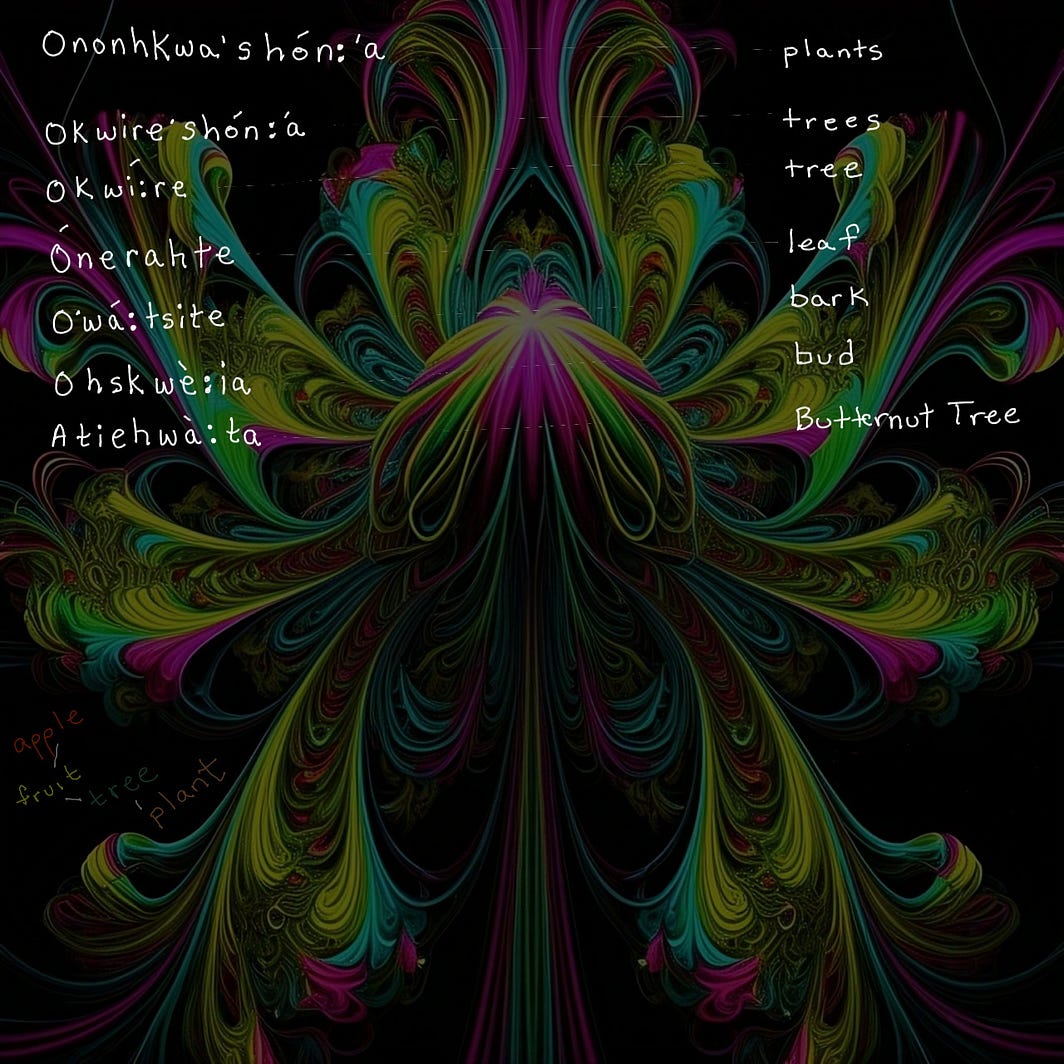
AI Connection:
- Kanien’kéha Revival & Retention techniques (MohawkLanguage.ca) follow a fractal-like learning process — repetition, layered understanding, and cyclical reinforcement. AI models fine-tuned on these patterns can better support second-language learners.
- Nature-based AI models, inspired by fractals, can help simulate Onkwehonwe decision-making processes, recognizing patterns in diplomacy, governance, and seasonal cycles.
Example: The Recursive Structure of Language & Thought
Fractals are self-similar structures, meaning their patterns repeat at different scales. This concept appears in natural languages, Onkwehonwehneha AI and AI large language models.
Language as a Fractal Structure
- In Kanien’kéha and other languages, words and meanings build recursively. Many words contain root morphemes that repeat in different forms and contexts, creating meaning in a self-similar way (self-similarity).
- Polysynthetic languages such as Kanien’kéha dialects combine smaller units into complex expressions, mirroring fractals in nature.
- AI large language models (LLMs), such as GPT, use hierarchical embeddings where words, phrases, and sentences are structured in layers, like fractals.
- The same grammatical rules are applied to simple sentences and complex paragraphs.
- The same patterns of word usage are seen in different genres of writing.
Fractals in Nature & Onkwehonwehneha Knowledge
- Tree branching, river networks, horn growth, and lightning strikes follow fractal geometry.
- In Onkwehonwehneha storytelling and oral traditions, knowledge is structured recursively. One story leads to another, revealing deeper truths depending on how it is interpreted at different life stages. The Creation Story is one example with simple shortened versions to complex longer versions and The Thanksgiving Address versions, also known as Ohénton Kariwahtehkwen is another example.
AI Training and Fractals
- AI models “learn” through feedback loops that refine patterns at multiple scales, similar to fractal growth.
- Deep learning networks often mimic fractal structures — where earlier layers detect simple patterns (edges, sounds, syllables) and deeper layers detect complex ones (words, sentences).
- Self-attention mechanisms in transformers (like GPT) behave fractally, capturing small details and broad contextual patterns simultaneously.
Math Example: The Mandelbrot Set
A classic fractal equation is the Mandelbrot Set, defined as:

Where:
- z represents a complex number.
- c is a constant that defines the fractal’s shape.
- The equation is iterated many times, and depending on it’s starting value, it either diverges to infinity or remains bound in a fractal pattern.
This mirrors recursive structures in AI and language models, where a small change in input affects the entire outcome in a non-linear way.
Research and Applications:
- Linguistic Analysis: Fractal analysis is used to study the structure and organization of language and to understand how language changes over time.
- Computational Linguistics: Fractal patterns are used to develop more accurate models of language generation and understanding.
- Fractal Grammar: Some linguists state language can be understood through a fractal grammar, where the rules of grammar are applied recursively at different levels of complexity.
Examples of Fractal Patterns in Language:
Discourse Structure: The way information is organized in a text, such as topic sentences, transitions, and summaries, also exhibit fractal patterns.
Nesting of Clauses: Sentences can contain subordinate clauses within main clauses, creating a nested structure.
Word Formation: Prefixes and suffixes can be added to words to create new words, and these processes can be repeated to form larger words.
Audio version of this article: https://aiarts.medium.com/ai-and-language-learning-from-fractal-structures-fe2fdbb53db1

 AIGeneration.blog